![]() |
Solaris Farms Blog...Nate Bremer and Family | Topics Index Farm Images Solaris Farms |
![]() |
12.19.12 Well, winter will arrive tonight in force! Our area has forecasts for 14" of snow and high winds. No school tomorrow due to dangerous roadways, a good thing since drifting here will likely prohibit me from leaving the farm. The image to the left is what our fields looked like after the rains. Odd that the sun is showing in the image since it only was visible through the heavy cloud cover for only a few minutes in the last couple of weeks. Tomorrow the field should be completely covered and ready for what winter has to dish out. Many people have been purchasing plants on the Solaris Farms site for their gardens next year and the snow cover should insure some healthy plants-I hope. Winter protection in our exposed area can make a huge difference come spring. Stay warm and have a good Holiday Season. Nate |
|
|
12.16.12 The all new and updated Solaris Farms website is up and running! Lots of new plants and images. We will be adding new plants and making adjustments to the website over the coming winter months as needed. If you have difficulty using the site, we always appreciate your input. I've been spending may hours in front of the computer each day as the weather here in Wisconsin has been poor for outdoor activity. Lots of rain on frozen ground here over the last two days. Plants are asleep and I'm dreaming. Merry Christmas and Happy Holidays. Nate |
![]() ![]() |
6.3.12 Well, Peony bloom season is winding down and unfortunately it is one of the busiest times of the year. School is winding down, daylily shipping is nearly completed, weeding the fields is in full swing and spring planting and field maintenance is a daily task. If only the days were 40 hours long! The Peony bloom was exceptional for tree peonies and less so for the herbaceous plants. Many of the herbaceous plants had freeze damaged buds and the plants were adversely impacted by the an overly wet and cold period this spring. Botrytis (a fungal disease) was and still is showing it's deadly affects on all peonies. Tree peonies are still loosing stems and herbaceous clumps/new plantings are showing wilting/death, even with very the very dry conditions the past 3 weeks. The older Saunder's hybrids seem to be most affected by the conditions and all that can be done is to remove diseased parts from the fields and gardens. On a positive note, many new seedlings bloomed for the first time this year with promising blooms. Peony seedlings are something special in my eyes as they are the fruits of past efforts and have the promise of better things to come. Among the the beauties this year were numerous full double tree peonies, of which a few carried their buds upright and within full view. Typically heavy double tree peony flowers hang down and are often hidden in the foliage due to their weight, thus good carriage is always a welcome sight. A large number of these advanced generation hybrids are continuing their bloom by producing new stems and blooming side buds, which has extended their seasons greatly. Seedlings with Rosalind Elsie Franklin and Seidl's #50 (garden named 'Sedona') as parents have been the most exceptional for flower color, form and carriage. A few of them have already been selected for further propagation and hopefully registration. The early herbaceous advanced generation hybrid seedlings have also shown great promise. Many fine doubles have been photographed and cataloged, most coming from unregistered seedlings from Bill Seidl's program. Lemon Chiffon seedlings have been rather disappointing due to poor foliage and stems, which was a surprise to me. On the other hand seedlings from Bill's 'The Little Corporal' (RELSW6) were spectacular! Many fine brightly colored single flowers were carried on strong short stems and a couple of fine brilliant red doubles showed up in the row as well. Now to grow these on and find out if they will stand the test of time. Now a bit of rain would be welcome to settle the spring dust and help the daylilies and Lilium along. Many of the Lilium were heavy damaged by late frosts and will not bloom this year, something that seems to happen every couple of years. |
|
|
5.1.12 After some very hard freezes last week we have finally begun to warm up! Some plants were heavily damaged last week due to low temps and overall conditions. A number of Lilium, especially the trumpets received heavy freeze damage and some will not grow further this year. Lilium are interesting plants though, most of those damaged will go dormant for the summer and re-emerge in the spring 2013. They will be a bit smaller, but should recover. Some daylilies were also heavily damaged, with a good amount of dead and spotted foliage. They will recover, but will need time. A number of spring shipping orders will need to be refunded for plants that hit hard. Peonies also received some damage from freezing, but most of the difficulties have come from Botrytis (a fungus). A good number of herbaceous plants have lost stems due to the disease, which prospers in damp cool conditions. Those with the worst damage from the disease were older A.P. Saunders cultivars. Unfortunately, a number of the cultivars were completely decimated by the disease and customers that ordered them will be refunded. On the other hand, the lutea hybrid tree peonies have done fairly well with the adverse conditions and should bloom rather heavily. This is mostly due to the very warm average temperatures we experienced this winter. A rather large number of new herbaceous hybrid seedlings will also be blooming for the first time this year. We are very excited about these because of their rather unusual pedigrees. Many are advanced generation hybrids from Bill Seidl's breeding program. A couple that are drawing interest in bud are... Tranquil Dove x Picotee; Lemon Chiffon x Mac Grand; and Pastelegance x Mac Grand. We'll take lots of pictures and hope that some are keepers. |
|
|
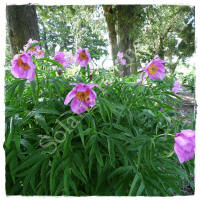
4.21.12 The climate continues to be on a roller coaster after a very warm month of March. Numerous freezing nights, a couple of warm days and many miserable windy/cloudy/rainy days have ensued. The plants continue to grow, but soooo slowly. Peonies continue to make the most growth and I would suspect that by next weekend a couple of the earliest tree peonies will be showing color. Paeonia mairei is now blooming, showing off it's wonderful single pink flowers(at left). As much as I don't like the temperatures, anything that is flowering has had a long bloom season thus far. We've enjoyed daffodils, forsythia, magnolias, hellebores and an assortment of other early spring flowers for what seems to be a much longer period than I can ever remember. If we don't get too cold, the same long bloom season should apply to the Peonies. Many of the Lilium are poking their heads up now as well, hopefully they don't encounter a very hard freeze like the one we experienced 3 years ago. That freeze wiped out most of the flowering for the summer of 2009. Fortunately, Lilium are fairly resilient plants that will lay dormant after a disaster and resurrect themselves the follow year. The daylilies continue to make slow progress. We know many people are anxious to get their spring orders, but they are unfortunately not ready to be dug. |
|
Shrub Peony: 'Taiyo' Herbaceous Peony 'Seidl/Tolomeo Red Tenu hybrid' |
4.5.12 Many gardeners have been wondering how this cold snap (sub freezing night time temperatures) will affect their plants. I'm wondering as well! The Peonies have thus far handled temperatures down to 28ºF very well, although we've seen some rotting young shoots on some of the herbaceous plants. The rotting plant stems on some of the plants is likely due to cool weather combined with fairly high ground moisture. Some damage has been noted on daylily foliage as well, although these plants typically recover quickly. Tonight's temperatures are forecasted into the lower 20ºF's. This will be something new, as I don't know exactly what the lowest temperature the plants will tolerate. Growth has been very slow over the last week, but still the plants continue to make growth. Cool night temperatures will continue to occur over the next week. Many people have been contacting me about Peony bloom, but I've not been able to make any type of educated guess as progression has been erratic at best. Stay tuned, as bloom may come quickly or not. As to spring digging, we are still some weeks away from doing any serious transplanting, digging for shipping and dividing of daylilies. Ground temperatures are very cold at this time and the soil surface continues to freeze on some nights, indicating that not much heating has taken place thus far. Reports from western Wisconsin and Minnesota are that Lilacs are beginning to bloom, ours are only breaking bud at this time. The joys of having the world's largest refrigerator next door are in evidence (Lake Michigan). |
|
Helleborus 'Golden Lotus' Helleborus ' Metallic Blue Lady' Strain Helleborus 'Cherry Blossom' |
3.31.12 A much welcome spring break(from teaching duties) has arrived and it looks like weather will be pleasant enough to do some outdoor work during the coming week. Plants continue to progress slowly with the somewhat cooler temperatures of the past week. I'm thinking we will see a somewhat increased growth again this week due to temperatures forecast into the lower 50's for highs. Helleborus are a new plant we are starting to propagate and they are in bloom now. At this point we are not ready to sell these plants, but are looking forward to doing so in the coming years. Most of the plants we are growing are seed strain seedlings and we are doing some hybridizing of these plants. If you aren't familiar with this wonderful perennial, read on. At right is an example the Helleborus 'Picadilly' strain. These small, shade loving plants (20"tall ) produce palmate evergreen foliage of dark green coloration. In our climate the winter kills the foliage exposed to winter air, but new growth replaces the old wind/freeze damaged leaves in early spring. Flowering usually takes place in mid April to May in northeast Wisconsin. This year much earlier due to climate anomalies. The little 1.5" to 3" flowers are borne on stems that can carry from 5 to 20 buds. The flowers open in colorful shades of purple, rose, cream, cream with spotting and other variations. After a couple of weeks the petals turn green on all flowers and often remain for more than a month. After blooming the plants grow attractive foliage that remains throughout the season. Their culture is relatively easy. Good garden soil that drains is require and some afternoon shade to protect the plants from the mid day sun is all that is necessary. We don't have much shade on our farm so they actually receive more sun than is recommended , but they grow well nonetheless. Shadier locations allow the plants to grow more attractive and larger foliage. They do like evenly moist soil, but are very drought resistant (show little effect from very dry soils). Even though bloom occurs early, the plant's foliage is extremely attractive throughout the rest of the growing season and adds wonderful texture and interest to the garden. Hellebores are slow growers, but live for many years, given reasonable care . A fellow gardener in our area has plants that are more than 20 years old. After some years plants may be divided in the fall if one would like to spread them around a bit. They can also be raised from seed if you are patient. More will be posted about these wonderful little plants in the future. |
![]() Shrub Peony (#50 x REF) Herbaceous Peony 'Seidl/Tolomeo Red Tenu hybrid' Herbaceous Peony (Bill's Best Yellow x #NB49) |
3.27.12 Cooler weather has finally arrived, in fact last night our temperatures fell to 28°F. Plant growth has been quite extensive this past week, with almost all showing signs of emergence. The few daylilies that have broken ground are still loaded with natural resistance to cold as are the herbaceous peonies. Many tree peonies already have leaves developing, but show little if any sign of damage. How the cold will affect flowering is still an unknown. From past experience with freezing temperatures during bud development, we won't see damage until blooms begin to swell. Tree peony buds will often stay green and appear viable, but do not develop further once freeze damage has occurred. At what point in bud development tree peonies are adversely affected is not known, but I suspect we may find out this year. Over the next week more night time freezing temperatures are forecast for our area and this will provide a test for these plants. Paeonia mlokosewitschii, a variety of Paeonia duarica has heavily folded emergent leaves with fuzzy covering at first. Some plants of this species arise from the ground with deep red foliage, others a lighter coloration. In any case, they appear prehistoric and are quite the conversation piece. The herbaceous hybrid seedlings are emerging as well and are always of interest. Yesterday, Ethan (my son) and I were admiring a single cross (Bill's Best Yellow x #NB#49) of more than 100 seedlings. The many little seedlings had a wide range of foliage coloration and leaf structure, even if they had the same parents. Ethan made comment on the large range of genetic variation expressed in this block of small seedlings. Hopefully in a couple of years we will see the same type of variation in the flowers! Growing seedlings of nearly any plant is extremely interesting due to the wide range of variation expressed in the offspring. Tree peonies are no different. A number of years ago I made some crosses involving Bill Seidl's 'Angel Emily', a rockii hybrid. 'Angel Emily' is a gorgeous plant to watch in early spring as it unfurls its red tinted leaves, but it's seedlings are even more intriguing. Any number of our 'Angel Emily' seedlings have extremely dark lacey foliage with varying leaf structures. A select few plants have leaves that are more finely cut with smaller leaflets than any plant we've ever seen and this characteristic alone makes them worth growing. We can't wait to see if the flowers are equal to the beauty of the plants themselves. |
![]() Shrub Peony 'Renown' |
3.21.12 After two weeks of 60°F to 75°F high temperatures plant growth has commenced. While most of the plants have not yet emerged or are just beginning to, the tree peonies have made the most progress. Many small buds are now showing among the whorls of leaves that are starting to grow out. This is the earliest emergence that we have seen on the farm to date and it's a bit scary. Temperatures normally go well below freezing at night during March in northeast Wisconsin and daytime highs are around 40°F. What does this mean for us? If temps can hold above the freezing mark or fall a degree or two under we should be safe with bloom, but if they go to their normal lows most flowering will be eliminated and plant damage will occur. On another note, the herbaceous peonies and daylilies have yet to emerge as soil temperatures are still very low. These plants are safe for the time being. I know that many people to the south of us have daylilies, Lilium and all types peonies in above ground growth already. We still have frost in the ground in our shaded areas and it will take some warm rainfall to eliminate this to warm up all soils. Lake Michigan is giving us afternoon on-shore cooling at this time and this will likely continue through all of April, which will slow plant growth more. This isn't necessarily a bad thing, since it keeps our plants limited in their growth and protects them from the big swings in temperatures that inland gardeners have to deal with. On the downside, people wanting their spring shipments will not get them as early as they would like because our plants have not progressed enough for digging. Later this week we will see a mild cool down to highs in the 50°F's. This should slow things somewhat and that is probably a good thing. No freezing temperatures are forecast, although a few nights will approach the mark. I'm keeping my fingers crossed, as there are more tree peony buds than I've ever seen here at Solaris (we had an easy winter). |
![]() |
3.2.11 Finally, we had a snow storm! Not much to report other than the snow and the prediction for temperature well above freezing for the coming week. The moisture is certainly welcome, as we've had a rather dry winter and this will help in spring green-up. Plowing the farm drive was incredibly difficult due to the soil surface being thawed below the snow. Unfortunately the plowing was needed for the lower clearance cars to move in and out of the farm. Frost still exists in most of the soil, although not much. This should leave us in the upcoming week. Once this happens, our early growing and blooming plants will begin to show themselves quickly. |
![]() |
2.19.12 Presidents Day. This year I might dub it as the beginning to the 'month of mud'. As most in the upper mid west know, we've had a snowless winter. If you look at the image you can see a bit of snow, but that is a drift and is the only place in the garden that had any snow cover. We've had a couple of snowless winters in the past decade and they were disastrous for plants. I don't believe that will be the case this year. Our area had ample rainfall in autumn and temperatures went below 0 F, only three or four times during January and February. The previous snowless winters were drought years carried into winter and temperatures went very low for protracted periods of time. Now we are dealing with above average temperatures not usually seen until the end of March. Mud is in abundance and the frost appears to slowly be leaving the ground. I've had numerous emails from gardeners reporting growth of Peonies and Lilium beginning already. Unfortunately, this is far too early, as we may still see some fairly cold weather. The plants will likely survive, but not bloom well (if at all) this coming growing season. Now is a good time to do some pruning on tree peonies, removing old flower stems and cleaning up around plants. If herbaceous peony foliage was not removed from the garden last fall, it should be done now to prevent disease. If you have tree peony grafts under plastic or in cold frames, remove their covering and let the air get to the surface. I removed our cold frame covers today and found that the soil within the frames was completely thawed, but the plants still had pushed through the soil surface. The removal of the covering should allow cooler air to slow any early birds from emerging too soon. Last year was a heavy snow year and I couldn't get the covers off until later. Quite a few of the little grafts had already emerged and were later frozen off due to late freezes. It a good thing to put grafts into sync with the season if possible. |